Special FeatureCalifornia University Admissions Guide (opens in a new tab)
Vellum Institute is a small, application-based online institute built around live faculty seminars. Vellum Fellows are a selected group of high school students who take a live seminar with a professor from a premier university, an expert in their field with strong research and teaching credentials, then go further with optional, supervised one-on-one guided research or apprenticeship.
At the small set of schools most families are chasing, acceptance rates have declined by about 42% on average over roughly a decade, even as application volume climbs. A stronger score does not answer that. A real, faculty-vouched intellectual relationship starts to.
First-year acceptance rates for Fall 2015 or Fall 2016 versus Fall 2024 or Fall 2025, depending on the school (Harvard: Classes of 2020 and 2029). Rates are rounded to one decimal; the 41.5% unweighted mean uses unrounded rates from the sourced counts. The chart follows the dataset compiled 11 September 2026.
Sources: Figures are drawn from each school's own published Common Data Set filings, admissions office disclosures, or institutional research pages. See the sourced table and dated citations.
Grades and a demanding curriculum still come first. An enrichment effort does not replace that record. It sits beside it.
As the overview shows, tests now carry less weight for many readers, and the applicant pool keeps growing. A sustained guided research or apprenticeship can make visible what a transcript cannot: intellectual curiosity, follow-through, and a real artifact, a paper, analysis, or prototype, that gives Activities, essays, and recommendations something specific to describe.
That is the idea behind a Vellum Scholars-style effort. No single activity guarantees admission.
The overview below summarizes how a strong enrichment experience shows up in a portfolio.
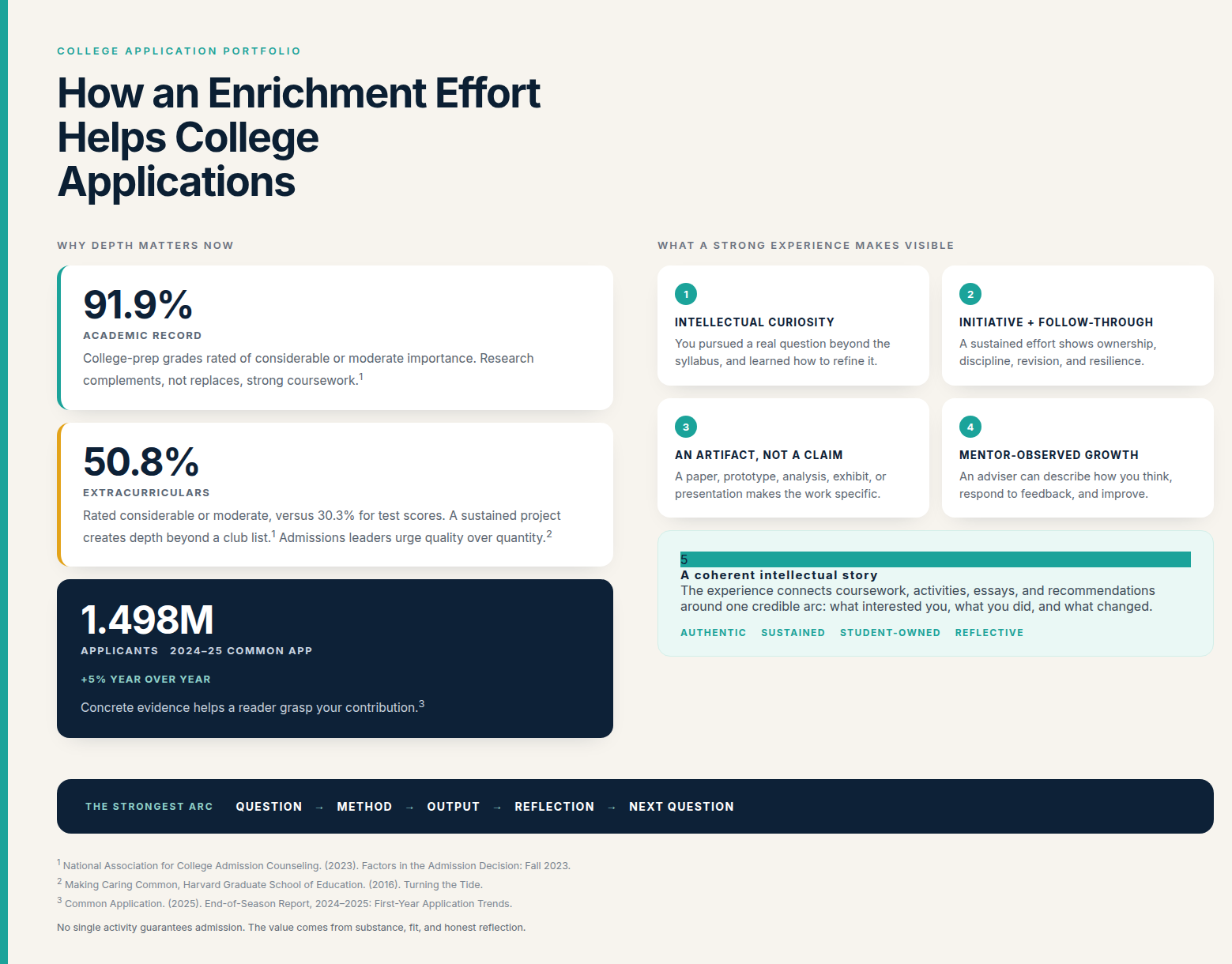
No single activity guarantees admission. Substance, fit, and honest reflection matter.
Most of what is sold to families in this category is either a generic mentor match or a credential shortcut. Vellum is built around something neither offers: one professor who works with a student from the seminar through optional guided research or an apprenticeship, so the relationship deepens instead of resetting with someone new.
Every course is taught live by a university professor, not a teaching assistant or a graduate student. Class size is capped at fifteen students to facilitate genuine participation and engagement.
Students apply to join a cohort, including a brief writeup on their college goals. That keeps the room serious and the discussion sharp.
After the seminar, a student can go further with the same professor through genuine one-on-one guided research or apprenticeship, building on a relationship that already exists rather than a cold mentor match.
The value here is not another line on an application. It is the difference between a student who has been exposed to a subject and one who has been made to argue about it, in front of someone qualified to push back.
By the final session, a Vellum Fellow can take an original position and defend it under real pushback from a professor, not recite something they read. That is a different skill from testing well, and it shows in an interview or an essay.
The reading load, the pace of discussion, and the standard for original thought mirror an actual university seminar. A student finds out what that level of work feels like before it counts toward a degree, not after.
Every seminar ends in a substantive project the student authored, not attended. It gives them something specific of their own to point to, instead of a vague description of an enrichment program.
Interdisciplinary and question-driven rather than built around a conventional subject silo. Every course ends in a substantive project.
How artificial intelligence is reshaping work, education, creativity, politics, relationships, and decision-making, ending in an independent project on a major AI-driven question.
Can business solve social problems? Students study real ventures, successful and failed, and develop their own proposal for a sustainable social enterprise.
Who are you online? How digital environments shape identity, attention, persuasion, and self-presentation, and what AI adds to questions of authenticity.
How emerging technology is reshaping global power: US-China competition, semiconductors, cybersecurity, information warfare, supply chains, and technological sovereignty.
How should firms account for environmental harm across operations and supply chains—and turn sustainability gaps into organizational value? Cases and readings cover climate impact, toxics, resource depletion, and product disposal.
How anime, manga, gaming, music, fashion, and technology made Japan a global cultural force, and how media shapes how nations are perceived.
Why smart people make irrational decisions: predictable mistakes, failed incentives, framing, social influence, loss aversion, and bias, explored through a student-designed behavioral experiment or project.
Tell us who your student is and which course interests them. It takes two minutes and does not commit you to anything.
We follow up within two business days. If it looks like a good fit, we send a full application ahead of our inaugural spring cohort.
Eight live, ninety-minute sessions with the same small group and the same professor, ending in a substantive independent project.
Continue with the same professor into one-on-one guided research or apprenticeship and leave with a real body of work behind you.
One price per course, shared directly with every family who reaches out. No bidding and no hidden tiers.
Shared directly once your student is matched to a cohort.
The seminar alone gives a student a genuine, college-level experience worth having on its own. For those who want to go further, a student can continue one-on-one with the same professor, someone they have already worked with, rather than a stranger assigned for the purpose.
This is where a generic "research program" and a Vellum guided research or apprenticeship relationship diverge. There are no gimmicks here, no publishing in an affiliated journal, no manufactured credential. We focus on real project outcomes a student can speak to with substance and highlight in their college applications, supervised closely by a professor who already knows how they think.
Eight hours of dedicated one-on-one time
Academically curious high school students, typically grades 9 through 12, who intend to submit competitive applications to top-ranked colleges and want a genuine seminar experience with a real professor rather than another generic enrichment product. Students apply, they are not simply enrolled.
You start with a short inquiry, then a full application ranking up to three courses in order of preference, along with a brief writeup on your college goals. Applications are reviewed on a rolling basis, roughly ten to twelve weeks before a cohort starts, with a final deadline about three weeks before the course begins.
No. A Vellum seminar does not carry AP, IB, or any other transcripted credit, and it is not designed to. Its value is different: a finished piece of original work to discuss in an application essay or interview, and an honest test of college-level seminar work before it counts toward a degree. Families are choosing a real intellectual relationship and a body of work, not a credit substitute.
Every course needs a minimum of eight students to run. If your top-ranked course does not fill, we place you in the next course on your list that does, or let you know as soon as we can so you can decide how to proceed.
No. There is no cost or deposit to express interest or to complete a full application. We share full pricing directly with each family once a student is matched to a confirmed cohort, before anything is finalized.
Yes, when the two courses meet on different schedules. We cap it at two courses per student per cohort. Indicate interest on the application, rank preferences for the second course, and we confirm the schedule works before admitting into both.
University professors with real subject-matter depth, not teaching assistants or graduate students. We list a course's faculty status plainly. A course marked FACULTY CONFIRMED has a professor in place; a course marked FACULTY UNDER CONSIDERATION does not yet, and we will not run it until it does.
Our inaugural cohort runs in spring 2027, February through April. We plan to add summer and fall cohorts after that, depending on demand.
It is optional, eight-hour, one-on-one guided research or apprenticeship with the same professor a student already worked with in a course. It is only available to students who have completed a Vellum course, we do not open it to outside applicants.
Most paid research programs match a student to a mentor they have never met. Ours follows a live seminar the student already completed with the professor, so the relationship is real before any guided research or apprenticeship begins. There are no gimmicks, no publishing in an affiliated journal, no manufactured credential. We focus on real project outcomes a student can speak to with substance and highlight in their college applications.
Start on the counselors page. Complete the short survey and we send The Hidden Rules of College as a free gift.
We keep a short survey for school counselors and independent advisors. Finish it and we send The Hidden Rules of College as a thank-you. The questionnaire is gated on a separate host; this site only explains how to get there.
Seats are limited to fifteen per course, and a course only runs once it reaches eight. Reach out early to get your first choice.
A parent or the student can complete this, whichever is easier. It starts the conversation, it does not commit you to anything. A member of our team will follow up within two business days with next steps and, if it is a good fit, a full application.
We read every inquiry as it arrives, not on one fixed date.
A single course of interest is enough for now; a full application follows.
This step starts a conversation. It is not a commitment or a charge.
A member of our team will reach out within two business days with next steps.
We could not submit your inquiry just now. Please try again, or email us directly at [email protected].
